
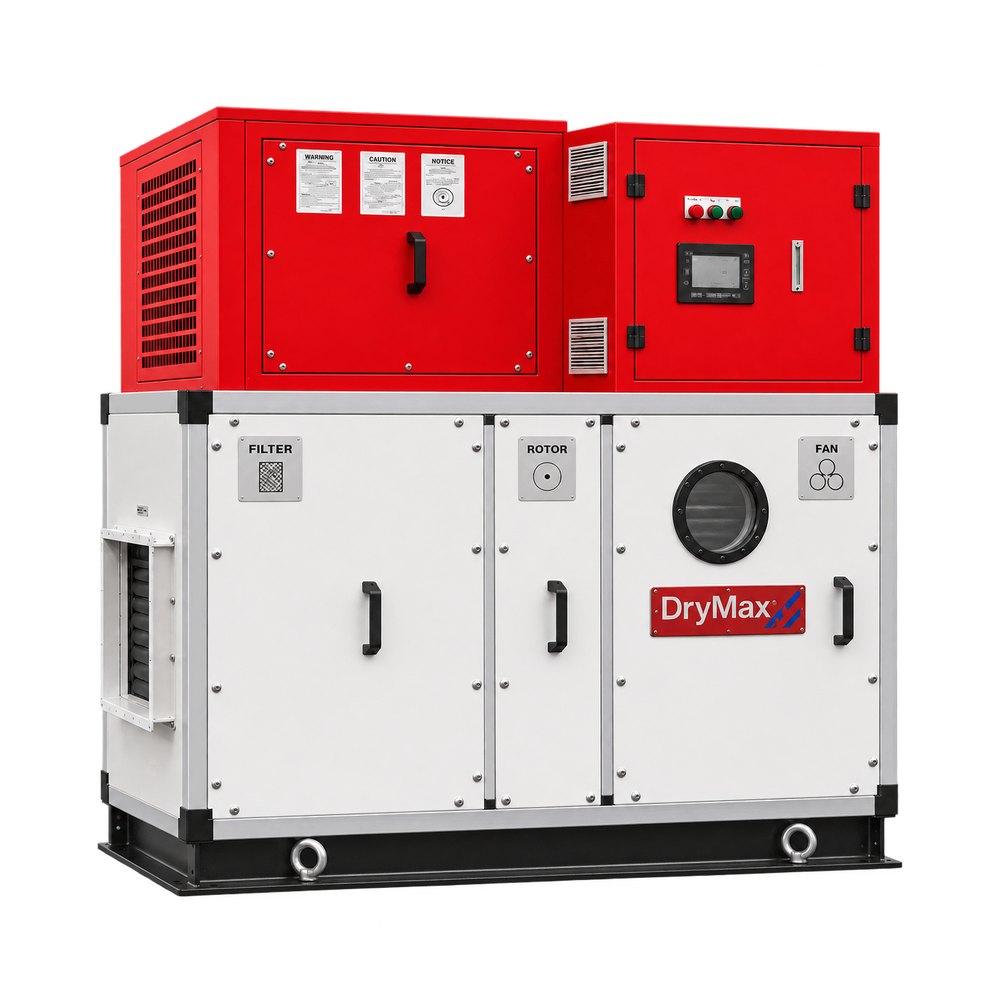
DRYMAX desiccant dehumidifiers
DryMax standard DM desiccant dehumidifiers (1,000–6,000 m³/h)
DM-1000 → DM-6000
Price on project basis
Contact us for a quote
Seafood plant ceilings sweat when the surface temperature of the ceiling and chilled pipes is below the dew point of the air in the hall. The vapour comes from washing water, flake ice, raw material and warm humid air leaking through doors. The lasting fix is to lower the air's dew point below the cold surface temperature with a dry-air unit (a DryMax desiccant dehumidifier or a CDP anti-condensation unit), not to blow fans or wipe the ceiling. ENCO builds CDP anti-condensation units at the DryMax factory (Cu Chi) and has installed units in the processing halls of seafood exporters in Tien Giang (accepted April 2026, ceiling free of condensation) and Hau Giang (steaming room measured at 84.4 %RH and 14.2 °C before start-up).
Seafood processing rooms are both cold and full of water vapour, so ceilings, ducts and chilled pipes condense easily. Water dripping onto conveyors and product is a food-safety failure that importers do not accept.
 Technical content byThS. Nguyễn Minh Thái · Updated
The dew point of the air near the ceiling a few degrees below the coldest surface (ceiling, chilled pipes, coils). ENCO engineers calculate the supply-air dew point from room temperature, surface temperature and the vapour generated in the hall.
Reference values. ENCO engineers calculate to the requirements and actual moisture load of each site.
| Area | Conditions and risks | How ENCO handles it |
|---|---|---|
| Receiving and washing | Vapour from washing water and flake ice rises to the ceiling | Dry air along the ceiling plus local exhaust at the vapour source |
| Processing, filleting and tray packing | Ceiling and ducts colder than the dew point; drips onto conveyors | CDP anti-condensation unit or DryMax desiccant dehumidifier supplying dry air along the ceiling |
| Corridors, cold-store doors and freezing area | Warm humid air enters when doors open, causing condensation and ice | Dry air for door areas and cold corridors |
| Packing and finished-goods store | Cartons absorb moisture, soften and go mouldy; labels peel | Stable humidity with dehumidifiers, monitored by data loggers |
DM-1000 → DM-6000
Price on project basis
Contact us for a quote
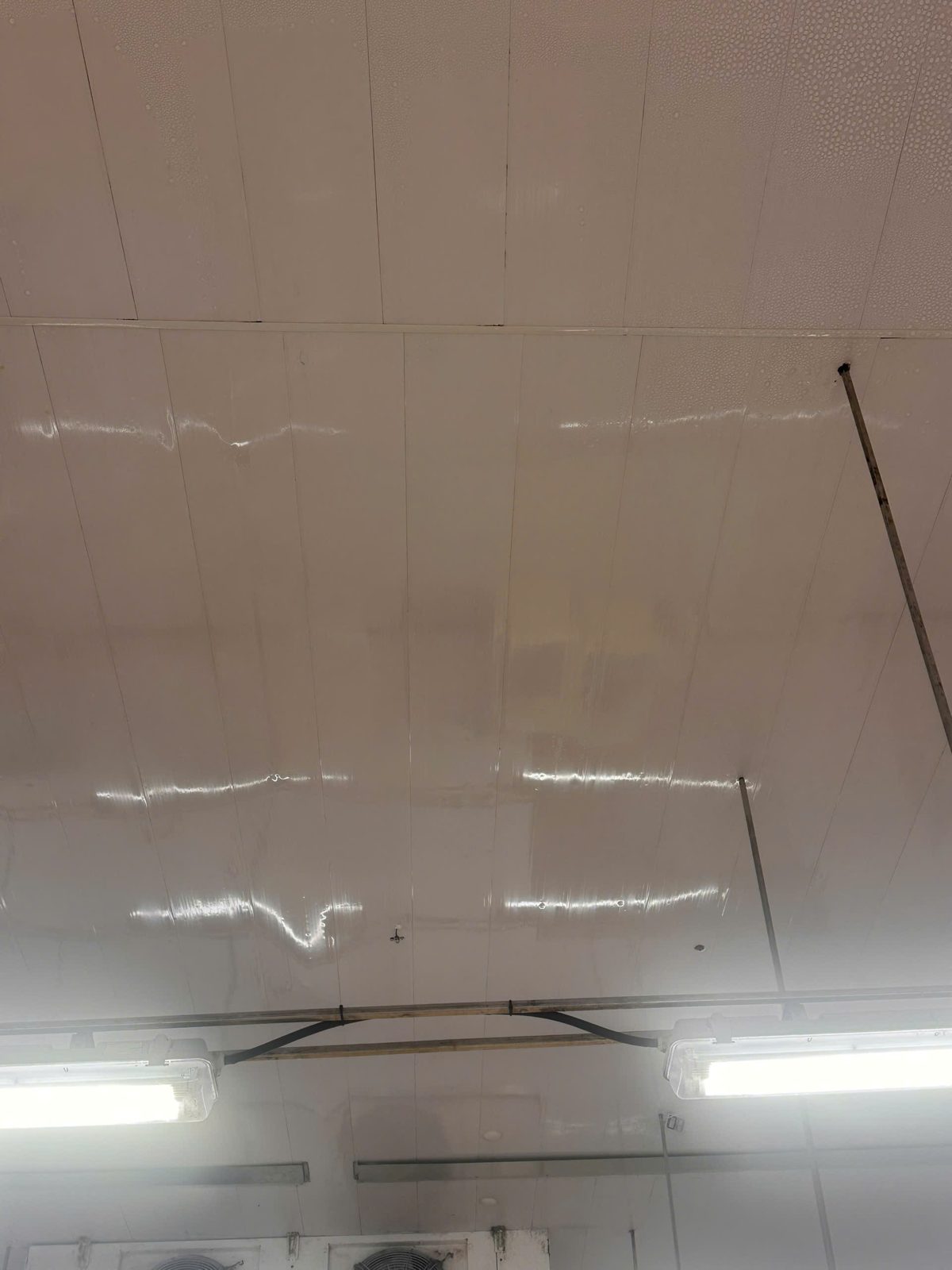
Hau Giang (now Can Tho) · 2025
Condensation control in the steaming room of a seafood plant with a DryMax DMFG-6E5 unit
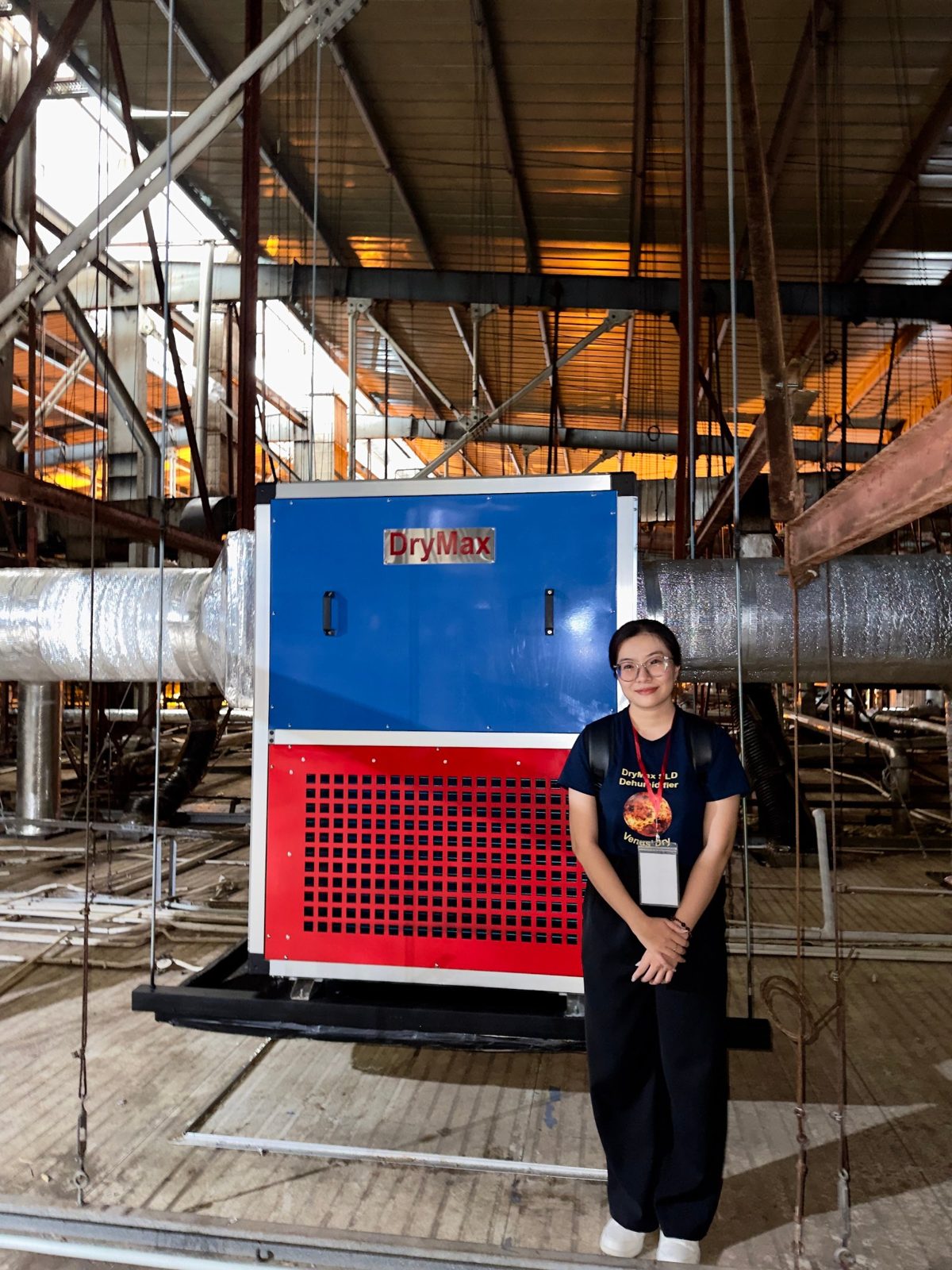
Tien Giang (now Dong Thap) · 2026
CDP-5000 anti-condensation units for a seafood processing plant
| Date | Province | Work |
|---|---|---|
| 04/2026 | Dong Thap | CDP-5000 anti-condensation units for a seafood processing room: installation, airflow balancing, acceptance |
| 03/2026 | An Giang | DT-200T dryer for anchovies |
| 12/2025 | Hau Giang (now Can Tho) | DryMax DMFG-6E5 for a steaming room: 84.4 %RH at 14.2 °C and a wet ceiling before start-up; supply diffusers improved and data loggers installed |
| 05/2025 | Ho Chi Minh City | DT-200He dryer for crab for a seafood company |
| 03/2025 | Vinh Long | HARISON HCD-192B and HCD-504B ceiling-mounted dehumidifiers for a seafood plant |
| 01/2025 | Vinh Long | HARISON HCD-192B ceiling-mounted dehumidifier for a frozen-goods storage area |
From ENCO service records; customer names are not disclosed.
Because the ceiling and chilled-pipe surfaces are colder than the dew point of the air in the hall. Processing halls generate a lot of vapour from washing water, flake ice and raw material, plus warm humid air entering when doors open, so the air's dew point is high. When that vapour meets a cold surface it condenses into droplets.
Not for good. Fans only stir the humid air and wiping only removes water that has already formed; as long as the air's dew point is above the surface temperature, water will keep forming. The dew point must be lowered by supplying dehumidified air.
Hardly. At low room temperatures a compressor unit removes little moisture and cannot pull the dew point low enough. DryMax desiccant dehumidifiers work well at low temperatures and deliver low-dew-point supply air, so they suit cold halls.
Hall dimensions (length, width, height), the room temperature you hold, ceiling or chilled-pipe temperature if known, number of doors and how often they open, daily water and ice use, and photos of where condensation forms. ENCO engineers survey free of charge to take further measurements.
In 2026 ENCO built CDP-5000 anti-condensation units at the DryMax factory and installed them in the processing room of a seafood exporter in Tien Giang (now Dong Thap): delivered and installed in January, airflow balanced in March, accepted in April 2026.
Send the room size, target humidity and the goods stored; ENCO surveys and proposes a solution free of charge.
Analytics cookies are only enabled if you agree. Details